
- Guide to Overnight Desert Safari
- On 20.03.2026
- sakshi tanwar
- Tags Desert Safari Dubai, Dubai
Stargazing in the Arabian Desert: A Quiet Escape From City Life
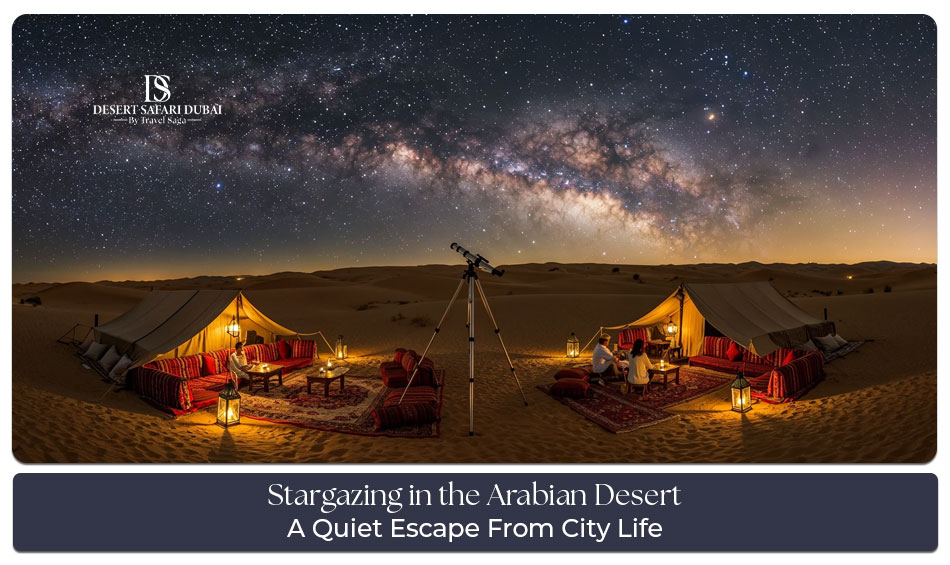
Have you ever looked up at the night sky in the middle of a city and felt like something was missing? Between the bright streetlights, the glowing billboards, and the constant hum of traffic, the stars often feel like a distant memory. For many of us living in busy urban hubs, the sky is usually just a hazy shade of orange or grey.
But there is a place where the lights of the world fade away, leaving only the ancient, twinkling glow of the universe. Stargazing in the Arabian Desert is more than just a hobby; it is a profound reset for the soul. It is a chance to swap the screen glare for star-fire and the city noise for a silence so deep you can almost hear the earth breathe.
Why the Arabian Desert is Perfect for Stargazing
The Arabian Desert is one of the most iconic landscapes on Earth. While many people visit for the thrill of dune bashing or camel trekking, the real magic happens after the sun dips below the horizon.
The Power of “Dark Skies”
In the city, we deal with something called light pollution. This is the artificial light that spills upward, masking the faint glow of distant galaxies. Because the Arabian Desert is vast and sparsely populated, you can travel just an hour or two away from the city and find “true dark.” Here, the sky isn’t just dark—it’s velvet.
Low Humidity, High Clarity
The desert air is incredibly dry. Unlike coastal cities where humidity can create a “haze” in the atmosphere, the desert air is crisp and clear. This lack of moisture means there is less interference between your eyes and the stars, making the Arabian desert night sky experience feel high-definition.
What to Expect During Your Desert Stargazing Experience
If you have never spent a night under the desert stars, you are in for a treat. With evening desert safari packages, it is a multi-sensory journey that begins the moment the golden hour ends.
The Transition to Night
As the sun sets, the dunes change from bright gold to deep ochre and finally to a soft purple. This is the best time to settle into your spot. As the blue fades, the first “diamonds” begin to pop out. Usually, you’ll see Venus or Jupiter first, shining brightly before the smaller stars make their appearance.
A Blanket of Stars
Once total darkness hits, the transformation is complete. You won’t just see a few constellations; you will see thousands of stars. The Milky Way often appears as a thick, silvery cloud stretching across the sky. It is a humbling sight that reminds you just how big the universe really is.
How to Prepare for Your Night Under the Stars
To make the most of your desert stargazing experience, a little preparation goes a long way. You don’t need to be an astronomer with fancy equipment to enjoy the view, but a few basics will help.
-
Check the Moon Phase: This is a pro tip! If you go during a full moon, the moon will be so bright that it washes out the fainter stars. For the best stargazing, try to go during a New Moon or when the moon is a thin crescent.
-
Bring Layers: Don’t let the daytime heat fool you. The desert loses heat rapidly once the sun goes down. Even in the summer, a light jacket is a good idea; in the winter, you’ll definitely want a warm sweater or a blanket.
-
Use Red Light: If you need to use a flashlight or your phone, try to use a red filter. White light ruins your “night vision,” and it takes your eyes about 20 minutes to fully adjust back to the dark.
Combining Adventure with Serenity
Many people choose to combine their celestial journey with a bit of daytime excitement. If you want to see the dunes during the day before settling down for the night, you can book a premium desert safari.
These safaris often include traditional Bedouin-style camps where you can enjoy a hearty dinner, perhaps some henna painting or a fire show, and then find a quiet spot away from the camp lights to look upward. It is the perfect balance of cultural immersion and natural wonder.
Frequently Asked Questions About Stargazing
Q. Do I need a telescope?
Not at all! While a telescope or binoculars can show you the craters on the moon or the rings of Saturn, the naked eye is perfect for taking in the vastness of the Milky Way and spotting shooting stars.
Q. When is the best time to go?
The cooler months (October to April) are generally the most comfortable for stargazing in the Arabian Desert. The air is clearer, and you can stay outside for longer without the heat.
Q. Can I see planets?
Yes! Depending on the time of year, Mars, Venus, Saturn, and Jupiter are often visible and much brighter than the surrounding stars. They don’t twinkle like stars do, which makes them easy to spot.
The Mental Benefits of Unplugging
We live in a world of constant notifications and “always-on” culture. This leads to a type of mental fatigue that only nature can truly cure. Standing in the middle of the dunes, looking at stars that are millions of light-years away, puts everything into perspective.
The quiet of the desert acts as a vacuum for stress. There is no Wi-Fi, no traffic, and no deadlines. It is just you, the sand, and the infinite sky. This sense of “awe” has been scientifically proven to reduce stress and improve overall happiness.
Conclusion: A Must-Do Experience
Stargazing in the Arabian Desert is an experience that stays with you long after the sand has been washed off your shoes. It is a reminder that there is a whole universe out there, waiting to be noticed. Whether you are a solo traveller looking for peace, a couple seeking romance, or a family wanting to teach your kids about the cosmos, the desert sky provides a show that no city cinema can match.
Next time the city feels a little too loud and the lights a little too bright, head out into the dunes. Just connect with thedesertsafariindubai.com for booking your tour and lay back, look up, and let the Arabian night sky tell you its ancient stories.